Research Question 1:
Are there any key words, phrases or word strings that denote non-Native ideas of nationhood, power, & sovereignty?

| shall | 55 |
| must | 21 |
| necessary | 30 |
| command | 34 |
| oblige | 18 |
Frontier Retreat (Wisconsin)

| must | 44 |
| shall | 52 |
| will | 203 |
| command | 54 |
| must | 44 |
| oblige | 11 |
| require | 9 |
| force | 35 |
Q1 Conclusion & Findings
You must vs. You can
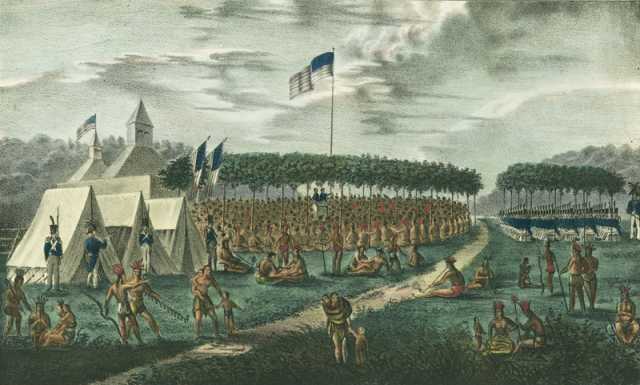
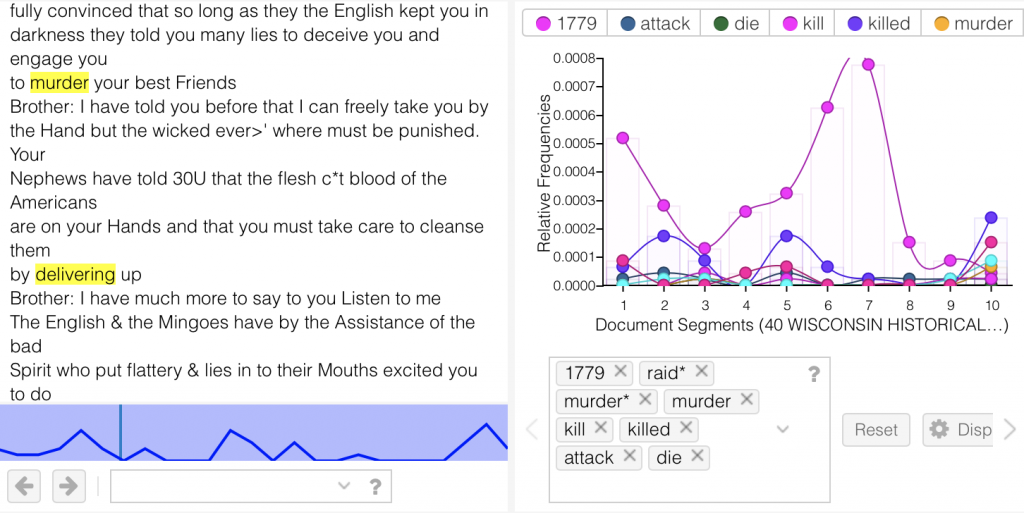
The frequent appearance of ‘command’ words indicates the passive-aggressive interaction between Natives and non-Natives (if the exchange was verbal and not violent). Power, sovereignty, and nationhood was undoubtedly a one-sided affair with colonists exerting their will on Native-Americans, where they even manipulated Natives to clash with one another in order to establish their own dominance. The conniving use of language where colonists demanded instead of requested created a hierarchy that led the United States to expect outcomes to unequally work in their favor. Egotism, patriotism and a loss of belief in colonial leaders led to non-Natives taking matters into their own hands to achieve their own means of power, sovereignty, & nationhood.
Research Question 2:
What are some of the implications of the United States’ method of “civilizing” Native Americans during the early establishment of the country’s nationhood?

Q2 Conclusion & Findings
Civilizing vs. Eradicating
This idea of “civilizing” Native-Americans was backed by administration and prominent political figures such as Thomas Jefferson. This was a totalitarian-like scheme which ridded Native-American tribes of their culture, which ultimately started with marriage. The Northwest region of the U.S. emphasized banning “Indianness” processes in marriage and follow American territorial laws. By following these laws, this set a precedent (especially in interracial marriages) that American customs were to be followed in every sense after, especially in raising children. Native-Americans were enticed to believe that they would have a voice in politics by conforming to U.S. customs, yet racial exclusion was still present (especially for women), leaving Native-Americans ditching their customs with nothing in return. This gave the United States power and furthered their idea of nationhood as they assured acclimation and equality but only tipped the scales in their favor.
Research Question 3:
How was power wielded in colonial and Native cultures? Were decision-making authorities delegated or was a singular person/group ultimate authorities within their societies?
Both Native and non-Native societies had chains of command implemented within their council delegations. Native concerns and grievances were voiced on behalf of the tribespeople by their respective Chief. In their council speeches, the Chiefs spoke on behalf of the men and women under their authority, often referring to issues involving the entire tribe—not just an individual member—regarding territorial encroachment, exploitation of resources and physical harm at the hands of settlers and enemy tribes.
European and American government representatives used military standards of conduct and protocol for establishing power and authority within their political ranks. This can be seen in the ranks of the various European participants in both the councils and accompanying correspondence of our corpus. Often times in treaty councils, these governors, generals, colonels, and majors would be the only people to speak on behalf of their respective governments. In a number of cases, one high-ranking official would be the singular voice for their party during the entire council, differing greatly from the Native parties where multiple chiefs would speak on behalf of their respective tribes in council meetings.There were two fundamental differences between the power structure of European and American governments and that of Native groups: First, whereas Native chiefs spoke of their people’s issues, inferring a bottom-up approach to their societies, European and American representatives referred to the authority bestowed upon them by their superior, whether it be monarchical or representative. These three images, created using the Links tool on Voyant, show the most-associated words with the terms “chief”, “king” and “commander”. As evident in the first image, terms such as “children”, “women”, “brothers” and “village” are directly or indirectly associated with the term “chief”.

Conversely, the images for the terms “king” or “commander” (short for “Commander-In-Chief”, an often-used military nomenclature for the President of the United States) show links to the terms “orders”, “governor”, “authority” and “instructions”. This can infer that these governments had a more top-down approach to power and authority within their respective culture and societies.


Q3 Conclusion and Findings
From these text analysis tools, we can determine that both Native and non-Native communities granted power to representatives in completely different methods. Native communities adopted a more egalitarian approach for the airing of grievances, which is evident in the words associated with the term “chief”.
European, colonial and American representatives, however, did not demonstrate a need to express concern on behalf of their fellow countrymen. Rather, their source of power was bestowed upon them at the behest of their superiors in their chain of command. Often times, this meant that their decisions were based on the orders of their monarchial ruler or elected official.
With more time and research using other methods of text analysis, more can be gleaned from these word associations from each involved party. However, the data thus far provides some evidence that the parties had different beliefs on the exercising of power and authority during these councils.
Question 4
Did the structures and thoughts of authority change or evolve over time, and were these potential changes based on interactions between the two groups?
With regards to concepts of authority between Natives and non-Natives, one can see trends in the use of two terms commonly used between the two parties. As illustrated in the first image, the term “father” sees a modest drop in usage starting in 1778, as British forces—regarded as a caretaker and provider for Native tribes during their reign—lose control over the colonies and American parties inherit these relationships post-revolution, often times without the acknowledgement of these roles inherent in the British/Native dynamic.

There are other concentrations of the term “father” being used, as evidenced in the concentration occurring between 1779-1781 and 1783-1785. After 1785, however, there is a visible decrease of use in the term, possibly implying that the “father/children” power dynamic between Europeans and Natives deteriorated and was later abandoned in American/Native relations.
Also interesting to note is the less drastic decreasing trend of the term “children” as time progressed. Between the years 1814 to 1822, there were multiple documents where the term “children” was used, with only one occurrence of the term “father”. This may signify a rather one-sided sense of authority between Native and non-Native speakers, with the non-Native forces using the term less in reference to a sense of caretaker to the Native population, but rather as a superior and authoritative figure to them.

Q4 Conclusion and Findings
From the evidence garnered with these tools, we can see a noticeable change in concepts of authority between Native and non-Native council speakers. With our analysis and other historical research, it is possible that this change—primarily between 1814 and 1822—can possibly be attributed to the decreased control of settled land from English (and to a lesser degree, French) control to American jurisdiction. And as evidenced from the conclusions of our other questions, this change in power dynamics certainly led to a deterioration of past structures of authority from one of stewardship to one of control and dominance.
Further textual analysis and reading of these documents can provide insights as to why the term “father” fell out of favor during this time, as well as contextual analysis to determine if the definition and use of the term “children” is linear across all these documents, i.e. if the term is used in the “father/children” form, or if it is used literally.
Methodology
For our project, we used primarily NLTK (Natural Language Toolkit) to dissect our research and Voyant-Tools to give it further context. Some of the sources varied from historical collections, including treaty councils, to recently written journals that accounted for the early relationship between Natives and non-Natives. Some of these sources included the Mississippi State Papers, Bethel Saler’s The Settlers’ Empire, the Frontier Retreat of Wisconsin and James Buss and Joseph Genetin-Pilawa’s Beyond Two Worlds: Critical Conversations on Language and Power in Native North America.
Sources
- Buss, James Joseph, and C. Joseph Genetin-Pilawa. Beyond Two Worlds: Critical Conversations on Language and Power in Native North America, 2014.
- Frontier Retreat of Wisconsin (1779-1781). https://archive.org/stream/frontierretreato00kellrich/frontierretreato00kellrich_djvu.txt.
- Mississippi State Papers (Clark Papers). (1771-1784). https://archive.org/stream/georgerogersclar19clar/georgerogersclar19clar_djvu.txt
- Saler, Bethel. The Settler’s Empire: Colonialism and State Formation in America’s Old Northwest (2015).