The use of figurative language by Native American speakers, particularly through natural metaphors and symbolism, has been well-recognized to the point of fueling stereotypical perspectives and portrayals of Native speech. Kathleen German in her analysis of Native American oral tradition notes that academic explanations for Native figurative language —namely that Indians were “simply fond of ornament” or that they used figurative language “as a mnemonic device in a culture dominated by oral tradition”—are not only limited, but contribute to the one-dimensional perspectives of Native American oration, rhetoric, and perspective (German 1998, 30). German counters these academic claims through her qualitative analysis of Native American speeches, a corpus that includes the documentations of treaty councils between Native and Anglo-Americans. She suggests that while the inconsistencies of transcribers and translators may affect micro-level analysis, a macro-level analysis of trends in the use of figurative language shows consistency in the ways in which it was employed by Native American speakers (German 1998, 30–31). Her argument that Native American figurative language was used in reference to particularized descriptions of objects and people, cyclical conceptualizations of time, influences of the natural order, and the daily experiences of Native witnesses creates a framework for our investigation (German 1998, 31).
Additionally, Natalie Inman’s work on the relationship between Native American kinship networks and the history of national politics emphasizes the role of kinship language in early American treaty processes (Inman 2017). Inman suggests that colonial powers worked to disrupt and replace the kinship networks of Native Americans through “civilization policy,” political agendas framed as efforts to “civilize” Native Americans (Inman 2017, 97–98). As a result, treaty councils involved the hybridized use of kinship rhetoric combined with the agenda of “civilization” as a negotiation tactic for treaties and economic agreements. While Inman’s work does not focus on the linguistic and rhetorical aspects of treaty-making, her findings suggest that a textual analysis of the treaty council corpus may reflect the politicization and evolution of kinship rhetoric.
How were symbols used by each nation?
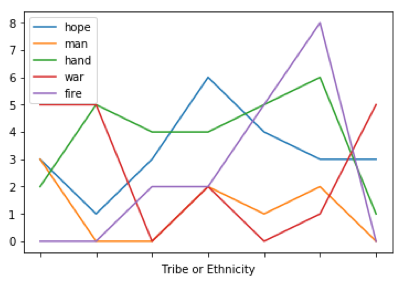
Due to the limited scale of our corpus, we decided to examine the use of figurative language by tribes who had the greatest amount of records, namely the Delawares, Wea, Miamis, Potawatomi, Oneida, Seneca, and Shawanese. To focus on the use of figurative language of specific tribes, we decided not to include the symbols of the wampum belt and pipes in this particular analysis, since they were symbols used by all tribes (Calloway 2013, 3,14-17). This means that our analysis prioritizes the language and presence of a select group of tribes, reflecting how a select few tribes had the greatest amount of representation and influence at the treaty councils.

Using a list of commonly-recognized, general symbols associated with Native American tribes, we used computational analysis to see if and which tribes used these symbols (Alchin 2017). The dominance of the word “brethren” in our analysis of the most frequently-used symbols in the corpus reflects the prevalence of kinship-rhetoric in the treaty councils. Also notable was the frequency of natural imagery in the corpus, with terms such as “moon,” “earth,” “lake,” and “fire” reoccurring. A look at the contexts for these references to natural objects, however, suggests that the contexts for symbolism varied. For example, terms like “lake” and “eagle” were not used as direct, individual symbols, but as references to specific locations like “Eagle Creek” and “Lake Ontario.”

This does not mean that we should exclude such terms from our understanding of Native figurative language. The emphasis on location by Native American speakers reflects how locations held symbolic significance, which is why choosing the site of a treaty council was a critical step in the negotiation process. (Fixico 2007, xvi)
Unexpected was the matching frequencies of the terms “peace” and “warrior.” To see if there was a correlation between the terms, we used Voyant’s Trends tool to analyze similarities in the distribution of their occurrences across the corpus.

The lack of a clear correlation between the trends of “peace” and “warrior” suggests that the symbols were not used in conjunction with one another and may reflect alternating moments of peace and tension. This would corroborate German’s claim that Native American figurative language was particularized to specific experiences and events.
We also used computational analysis to identify trends in the way each tribes used different symbols. The different frequencies and distributions of symbols across tribes continues to reflect the particularization of figurative language to specific contexts and people.
How is a certain symbol used to express positive or negative sentiment?
Increasing levels of abstraction made disambiguation of meaning more challenging, so we focused on concrete words to ensure that all the symbols we chose are clearly associated with the word counts on which we based our conclusions. For example, in order to understand the positive and negative connotations of this concrete symbolic language, we examined how the word “fire” was used in specific instances.
As Heidi Kiiwetinepinesiik Stark argued in “Marked by Fire: Anishinaabe Articulations of Nationhood in Treaty Making with the United States and Canada”, the Anishinaabe used fire as an image when they expressed their desire to protect women and children (Stark 2012). This suggest that the figurative language of fire was usually associated with positive sentiments related to the action of protecting the tribes or nations. When it comes to our specific research, it would be interesting to see if similar patterns emerge in the usage of “fire.” Using the vaderSentiment package in Python 3, we calculated the positive and negative score for each of the native leaders’ speeches in the corpus of treaty council notes (1754-1814). By aggregating the counts of the word “fire” in each of the speeches, we came up with a weighted percentage of the sentiment trends in our corpus. It seems that in the statements using the word “fire,” 75% were positive statements and 25% were negative. This conclusion seems to confirm Stark’s claim.
In future research, it may be fruitful to compare how individual tribes and speakers used the word “fire” to determine if there were variations in its meanings and usages across time and communities.
How was the figurative language of kinship used and did it change?
We analyzed the trends in kinship rhetoric using Voyant tools by tracing the distribution of the keywords “child*,” “father,” “brother,” and “brethren” across the corpus.

Trends revealed that while the collective “brethren” was used more frequently at the beginning of the corpus, it was used less frequently over time. In contrast, the individual identifier “brother” reflected spikes in usage at intervals that varied from the use of “brethren.”

Often, Native speakers used “Brother” (singular) when speaking to a British or American emissary, so its use indicates moments when they were speaking back to the colonizers. This may also reflect vacillation from using kinship language for collective unification to kinship language being used to directly refer to individual actors. Also notable is the distribution of “father” throughout the corpus. While “father” and “brother” had similar intervals in the first half of the corpus, the intervals began to alternate in the second half, moving away from language that establishes the equality of brotherhood to a more stratified distinction between “Father” and “child.” “Children” and “Father” have different frequency levels, but have nearly identical intervals, suggesting a correlation between the usage of both terms. “Father,” in particular, is used more frequently than any other kinship term by the end of the corpus, reflecting the growing strength of colonial powers reflected in evolving kinship networks and language.

Voyant’s Links tool, which reflects the collocation of terms in a corpus, corroborates these findings. The association of “father” with colonial powers is supported by the collocation of the term with “king” in reference to the King of England. Collocations for “child*” were “women,” “wives,” and “father,” reflecting not only how children and women were referenced together in negotiations to garner sympathy, but also the rhetorical infantilization that reinforced the authority of the Anglo-American “father” over Native American “children.”

The changing contexts for the use of kinship language, particularly to create hierarchies between the Anglo-American “father” and the Native American “children,” supports Inman’s argument that the evolution of kinship language was influenced political agendas.
For more on our technical process: https://github.com/lizhouf/dh199_spring19/blob/master/DH199%20Report%20Three.ipynb