Individual Assignment
DUE: February 12, 2019
Purpose: This assignment asks you to start analyzing your text corpus or a subset of it, which allows you to practice the skills you’re learning before your midterm exam. As you apply the text analysis skills to your own project, you will also practice one of the most difficult aspects of this work: thinking through what the methods reveal and what the results mean. The subsequent narrative you draft as you think through these questions can also be used in your final project.
Task: Analyze 1-2 research questions using at least 2 methods you’ve learned so far. Briefly describe the method you’ve chosen, why, and write a paragraph of analysis based on each method. Be sure to include any visualizations you create or code you write and its output.
Criteria for Success:
- (25 pts) List research question(s)
- (25 pts) Describe 2 chosen methods and why they are appropriate to your question(s).
- (25 pts) Visualizations or code + output for both methods.
- (75 pts) Analysis: Describe what the output shows and what it means in the context of your question(s).
Example:
Here is an example from the field of literature that explores the function of the word “come” in Hamlet. You can view the Voyant Tools suite pre-loaded with the play, separated by scene.
Research Questions: What function does the word, “come” serve in Hamlet? What does its usage tell us about gender and the political hierarchy throughout the play?
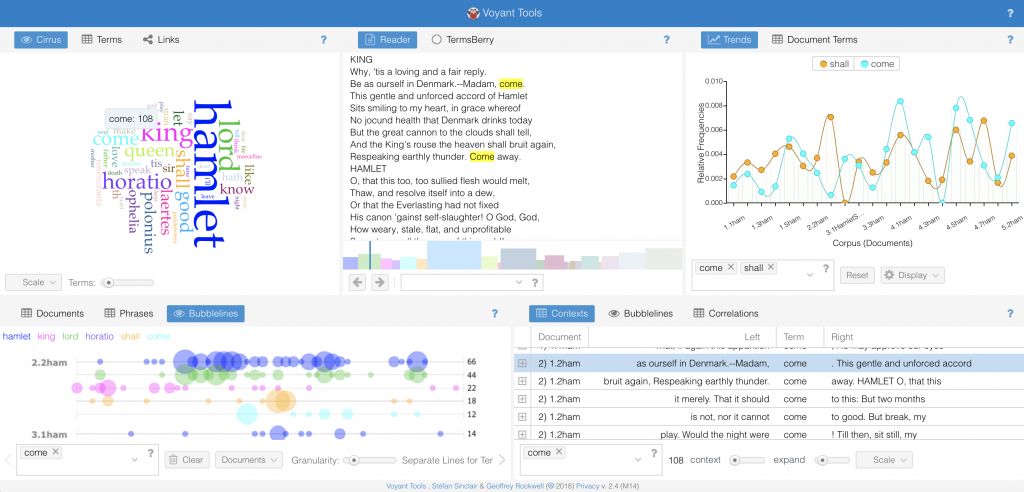
Methods: In Voyant Tools, we can use the Contexts and Reader tools to examine each case in which “come” appears in the text to develop a social hierarchy based on who gives and receives the command “come.” The Contexts tool shows either the most frequently occurring word (by default) in context or the word a user has input. The user can control the number of words shown on each side. By selecting an entry in Contexts, the passage will be highlighted in the Reader, which shows the text or corpus in its entirety. This feature is shown in the image below.
Analysis: The first appearance of the use of “come” as an imperative is Claudius speaking to Gertrude. In the second instance, Polonius is admonishing his daughter, Ophelia, who responds, “I shall obey, my lord”(1.4.145). The following hierarchy of characters’ power over narrative time results from an examination of each instance of “come” used as an imperative:
[Insert hierarchy]
The only time we see Claudius issue this particular imperative (“come”) to Hamlet is in the final scene of the play in which he has conspired to kill his step-son/nephew. We suspect that Claudius is worried that Hamlet will expose his treachery, thereby thwarting all his work to attain the throne. Cladius’ perhaps unrecognized, abstention from issuing a command to Hamlet that authority figures commonly used with those of inferior status throughout the play suggests an additional hypothesis. Until the moment when Claudius believes he has won and Hamlet is about to die, he implicitly recognizes Hamlet as the rightful heir to the throne by refraining from issuing the command, “come.” This is a hypothesis that could be further tested with more sophisticated and flexible tools, such as the Natural Language Toolkit package for Python.
We can also examine cases in which a command is given but not obeyed, as is frequently the case between Gertrude and Hamlet. Almost every time she tries to issue an imperative, Hamlet’s response is obstinate defiance. In 3.2.115-117, Gertrude requests Hamlet to sit by her, “Come hither, my dear Hamlet, sit by me.” To which Hamlet replies, “No, good mother. Here’s metal more attractive,” and sits near Ophelia. This appears innocent enough, but Hamlet’s response becomes much more aggressive in Act 3, Scene 4 when confronting Gertrude with her quick remarriage and even upends the parent-child power relationship by issuing multiple commands to Gertrude in response to her use of the imperative “come.”